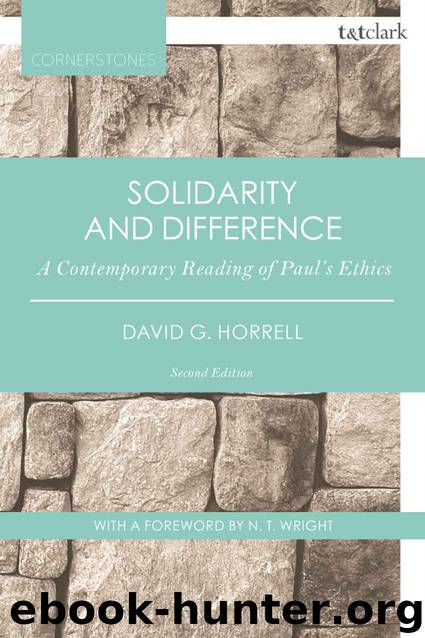
Solidarity and Difference: A Contemporary Reading of Paul's Ethics (T&T Clark Cornerstones) by David G. Horrell
Author:David G. Horrell [Horrell, David G.]
Language: eng
Format: azw3
Tags: s Ethics, A Contemporary Reading of Paul’
Publisher: Bloomsbury Publishing
Published: 2015-11-19T05:00:00+00:00
5.6 Conclusion: Distinct identity, shared ethics
We have seen how prominent in Pauline discourse is a sense of distinction, the conviction that the Christian community forms a holy body in the midst of an immoral, unholy world. This sense of distinction serves specifically to undergird a strong sense of positive group identity, giving a sense of favourable comparison with outgroups. Furthermore, the sense of group identity and boundaries is specifically grounded in ideas and practices related to the body: the positive assertion of the union of believers with and in the body of Christ corresponds with negative censure of competing unions, whether of a sexually immoral or an idolatrous kind. However, we have also seen that social interaction remains in a number of respects open, being circumscribed specifically where it connects with the key ideas and practices taken as crucial for defining and maintaining group identity and boundaries. Moreover, precisely where we find Paul stressing the ethical distinctiveness of the Christian community we also find that ethical norms and instructions are to a considerable degree shared – thus providing the basis for a comparative sense of positive group identity.79 1 Corinthians 5 provides a fascinating and important example here, for while Paul’s rhetoric and intentions are clearly focused on the purity of the community in distinction from the wicked world, at the same time he indicates explicitly that the ethical basis for his judgement is universally shared, in the wider world in which he operates. 1 Corinthians 6–7 reveal another important aspect of this collocation of distinct identity and shared ethics. Paul uses arguments about the believer’s bodily union with Christ to underpin a sense of distinct Christian identity and to motivate and legitimate ethical norms and specific patterns of behaviour: no immoral liaisons, and the containment of sex inside marriage. But the arguments he uses do not actually demonstrate why certain acts should be classed as ethical or unethical. Sex with a πόρνη destroys union with Christ while sex with an unbelieving spouse does not; on the contrary, the spouse is made holy through the connection with the believer. Paul’s arguments here simply presume that certain relations are wrong while others are legitimate; he assumes substantive ethical convictions about the legitimacy of sex within marriage, inherited from Judaism and also shared more widely, and gives them specifically Christian motivation and legitimation. In other words, Paul provides Christian bases for ethical judgements that are both taken to be self-evidently right, and reflect common ground with those who do not share this Christian world-view. Put differently, we may say that insofar as Paul’s treatment of sex expresses substantive ethical rules – do not visit prostitutes, do not divorce, etc. – it is rigorous, but hardly unique, in its socio-historial context. But insofar as it constructs Christian identity, through the overt signals and basic value orientations associated with bodily union with Christ, it constitutes a distinctive discourse (cf. also Moxnes 2003).
This juxtaposition of shared ethical norms and distinctive group identity provides a significant
Download
This site does not store any files on its server. We only index and link to content provided by other sites. Please contact the content providers to delete copyright contents if any and email us, we'll remove relevant links or contents immediately.
The Five People You Meet in Heaven by Mitch Albom(3550)
The Secret Power of Speaking God's Word by Joyce Meyer(3165)
Real Sex by Lauren F. Winner(3006)
Name Book, The: Over 10,000 Names--Their Meanings, Origins, and Spiritual Significance by Astoria Dorothy(2976)
The Holy Spirit by Billy Graham(2942)
0041152001443424520 .pdf by Unknown(2843)
How The Mind Works by Steven Pinker(2811)
ESV Study Bible by Crossway(2773)
Ancient Worlds by Michael Scott(2680)
Churchill by Paul Johnson(2577)
The Meaning of the Library by unknow(2563)
The ESV Study Bible by Crossway Bibles(2547)
The Gnostic Gospels by Pagels Elaine(2524)
MOSES THE EGYPTIAN by Jan Assmann(2411)
Jesus by Paul Johnson(2351)
City of Stairs by Robert Jackson Bennett(2339)
The Complete Dead Sea Scrolls in English (7th Edition) (Penguin Classics) by Geza Vermes(2269)
The Nativity by Geza Vermes(2226)
Ancient Near Eastern Thought and the Old Testament by John H. Walton(2220)
